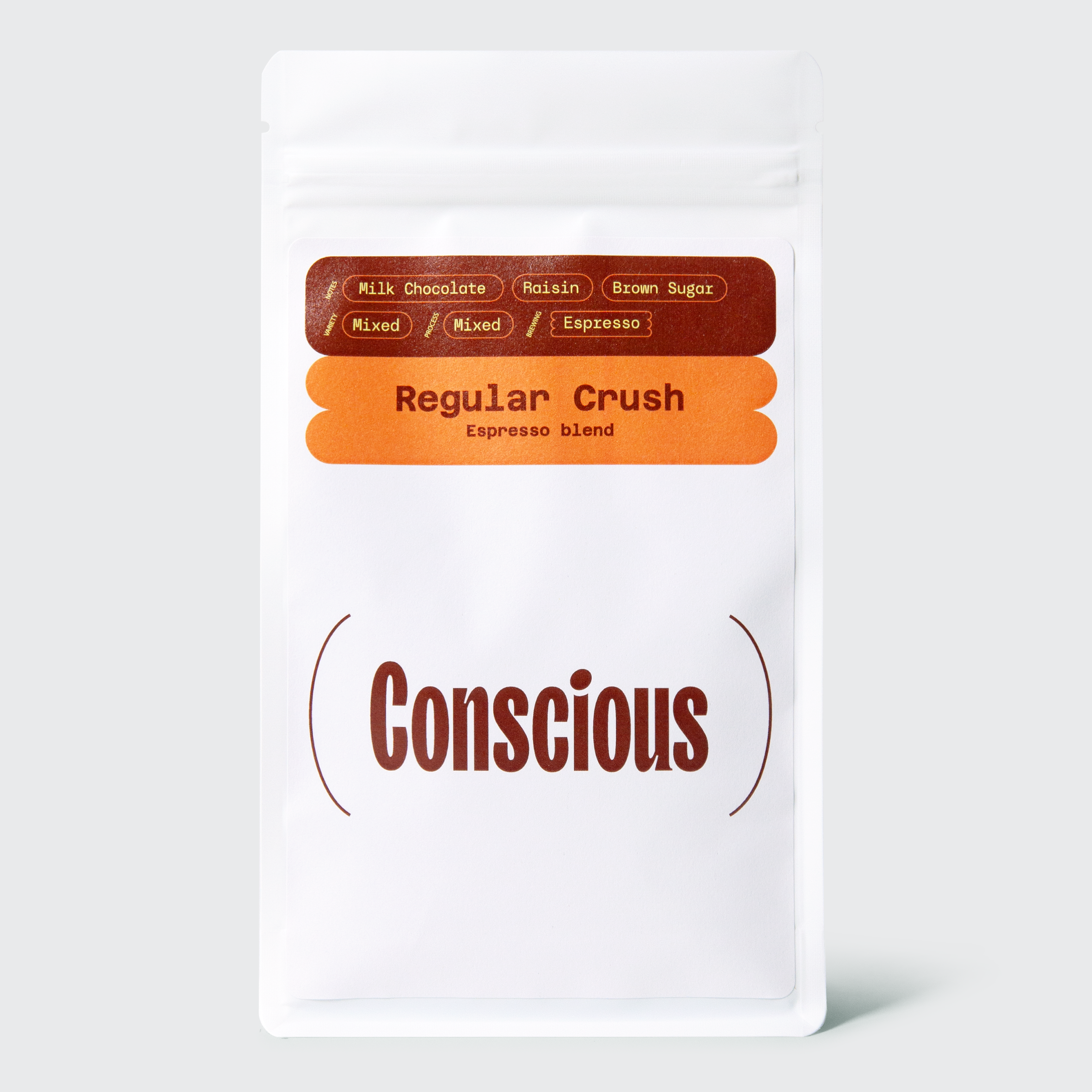


Regular Crush is our take on a classic, approachable espresso blend. The components of the blend rotate seasonally, based on what we think is tasting delicious at the time. But rest assured that it will consistently create a beautifully balanced cup, with milk chocolate and praline notes, a creamy texture and smooth finish. Pair it with milk or alt-milk or drink it black - it's as easy going and dependable as that local barista you've been crushing on.
We purchased this coffee directly from Fazenda Mió, whose farm is located in the municipality of Monte Santo de Minas in south-eastern Brazil. It is owned and run by the Pellicer family, who also export, import and store coffee. We sourced this coffee through Ana Luiza Pellicer, who represents Mió’s abroad. The farm is approximately 1,589 hectares, and sits approximately 900-1000 M.A.S.L. Roughly two thirds of the farm comprises coffee trees and native forest (in equal parts). The remaining land is used for milling and processing coffee, using state-of-the-art technology, alongside a eucalyptus plantation.
This coffee is a mix of catuaí, bourbon and mundo novo. The coffee underwent a natural process, in order to enhance its stone fruit acidity whilst retaining milk chocolate and caramel notes. The cherries were harvested (through a combination of hand-picking and machine harvesting) between May and June 2023. They were then dried on concrete patios for 14 days, then dried mechanically for 5 days. After hulling (using cross beater hullers and an oscillating screen grade to separate the cherries by size), the coffee was sorted (using optical sorting technology), then blended and bagged.
This iteration features a natural process Caturra from coffee farming families based in the Planadas Municipality, located in Tolima, center-west Colombia. Their farms, sitting between 1500-2150 M.A.S.L, boast soils rich with nutrients from volcanic ash.
We purchased the coffee from Cofinet. We have wanted to work with Cofinet for some time, given our shared values and approach to sourcing coffee. Cofinet not only produces coffee on its own family’s farms, but also connects other smallholder producers with speciality roasters, and supports those producers to learn how to better grow and process their own coffee cherries. Doing so helps such producers add value to their coffee and, in turn, increase their income.
Cofinet sources the coffee that forms the El Indio lot from two cooperatives in Tolima - ASOPEP (“Asociación de Productores Egológicos de Planadas”) and ASCI’SP (the “Association of Indigenous Coffee Growers of San Pedro Páez in Gaitana). The ripe cherries are selectively harvested based on ripeness criteria, then slowly dried on raised beds in order to achieve 11% moisture content. Each family then delivers the coffee to their respective cooperative.
The price of specialty coffee depends on both its quality and the cost at each stage of the supply chain from seed to cup. We break down the costs of each coffee wherever possible to show our commitment to transparency and paying high prices to producers for high quality coffee.
For further details on the prices below visit our Transparency Page.


If you're not sure which coffee is for you, or you want to try them all, then our discovery pack is just what you need.
Shop now